Be yourself; Everyone else is already taken.
— Oscar Wilde.
This is the first post on my new blog. I’m just getting this new blog going, so stay tuned for more. Subscribe below to get notified when I post new updates.
Be yourself; Everyone else is already taken.
— Oscar Wilde.
This is the first post on my new blog. I’m just getting this new blog going, so stay tuned for more. Subscribe below to get notified when I post new updates.
Mark Swaim observes that some people may question whether the study of space is still relevant, economically wise, or necessary. But anyone who thinks that space exploration is a waste of time surely has not heard of some of its convenient benefits to humanity.
In fact, did you know that NASA is responsible for plenty of life-changing modern technologies used today? The study of space has brought ideas outside of the planet and turned them into everyday solutions that have undoubtedly made life better.
Here are some of the best:
Mark Swaim stresses that there are loads more beneficial and practical technologies that are all thanks to the study of space. Remember this list the next time you feel doubtful about the necessity of exploring the last frontier.
As a kid, Mark Swaim used to think that falling into a black hole would mean instant death. Many others believe the same, thanks to the movies and TV shows that portrayed black holes as gigantic vacuums that destroyed everything in its path. However, this myth was debunked. Black holes do not have infinite mass, which means that unless you are traveling extremely close to them, you aren’t likely to get sucked in.
A common question Mark fields from the class is this: what actually happens when you do get sucked into a black hole? Do you instantly get crushed and destroyed, or does something more complicated happen?
Two Realities
At first, Mark Swaim was astonished to hear that reality would become split in two if he were to be sucked into a black hole. This effectively clones you and your existence. In one of the realities, your body would instantly be incinerated, which effectively kills you. In the other reality, however, you would fall into this black hole completely and utterly unharmed. What happens from there, scientists have yet to figure out.
Why Would This Happen?
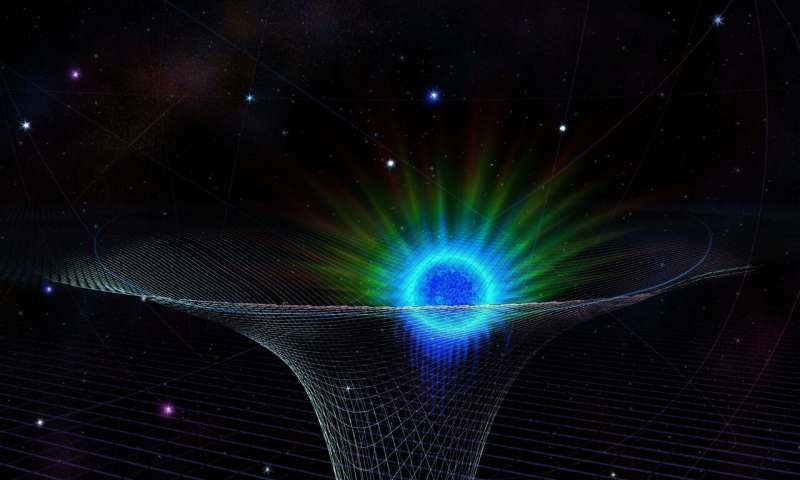
Black holes are where the laws of physics begin to break down. Through Einstein’s findings, humans found out that gravity can warp space, causing it to become curved. Mark Swaim shares that when stars begin to collapse and turn into black holes, space-time also becomes warped inside of it, twisting reality. The gravitational field found within these black holes is so strong that even light cannot escape – hence the term “black hole.”
As for what happens inside these black holes, no one really knows. People are dying to know, but it’s all speculation at this point, even with many astrophysicists dedicating their whole lives to attempt to find an answer. But Mark Swaim hopes that through the years, and the efforts of many, many physicists, more can be known about black holes.
Mark Swaim shares that every so often on a clear night, you catch a glimpse of a small streak of light across the dark sky. People refer to it as a shooting star, but it’s actually a tiny space rock. Its light is caused by the earth’s atmosphere causing friction to its outer surface. There are times in a year when a “shower” of these rocks enters the earth’s upper atmosphere and creates a light show.
The Sonic Boom
Bigger rocks can pass through the atmosphere and create a sonic boom plus a trail of rocky debris falling in its wake. Mark Swaim says that they are usually called space junk, and are what is left behind from a comet. Some rocks may even be asteroids, which may pose to be lethal to anything which happens to be in its path if it is big enough.
The Size of a Pea
However, there’s no need to worry since most are high-flying and silent shooting stars. They are about the size of the pea, which means you can stow an entire local meteor shower in your backpack. Each meteor shower happens about the same time each year or whenever the Earth heads into some long-lasting debris field.
Mark Swaim adds that whenever a big enough meteor bursts in the lower atmosphere, it can sound off a loud boom (the bigger the meteor, the louder the boom), and direct a band of light into the sky.
The Colorful Blaze
The earth’s gravity pulls at nearby space rocks. As they get tugged into the atmosphere, they experience friction, which releases a large amount of heat. This ignites the meteor and results in a fiery blaze that can unveil a range of colors.
The Great Radiant
Each meteor shower has a radiant, which is the point in the sky from which it appears to come from. This is the direction the Earth plows into the debris field. As the planet strikes, it hits the space rocks from that angle. Try looking straight at the radiant to see a quick streak of light, and look sideways to the radiant to catch the rocks’ long and vibrant tails.
Mark Swaim says that despite being called space junk, these pea-sized space rocks can sure create a brilliant light show.
China is set to launch its first interplanetary mission in July of this year amid the Coronavirus pandemic, which has severely hindered activity in the republic. Mark Swaim asks, will the outbreak hold up China’s launch for the Red Planet?
Mars Mission Situation Looks Good
China’s government implemented a series of enforced quarantine and travel policies in January to help stop the spread of the virus. This kept many employees, including those in the space industry, from going to work.
However, the China Mars Mission situation continues to look good, as they proceed with their plans to send a rover and an orbiter to Mars. Work at facilities for manufacturing and testing spacecraft and launch vehicles has gone on despite the blow to their labor force.
Increased Safety Precautions
Their workaround solutions included the use of safety precautions such as safety masks, elevator use ban, lunches boxed individually, and building disinfection.
Meanwhile, Mark Swaim notes that the Xichang Satellite Launch Center, located in Sichuan Province, has resumed launches. The country’s new coastal spaceport, Wenchang, is getting ready for two new rocket launches. One of these will test a new next-gen spacecraft and lay the groundwork for the country’s new space station.
The Long March 5
These are encouraging news for China’s Mars Mission, which is set to launch from the Wenchang spaceport in July.
China’s biggest rocket, the Long March 5, will launch the Mars Mission. It had a fruitful return to flight last December after a launch disaster in July 2017. The Long March 5, according to Mark Swaim, is progressing along nicely with favorable engine tests accomplished in January. The rover that will be sent to Mars also underwent space environment testing in the same month.
No official comment has been made about the mission, but as Mark Swaim observes, the country’s first solo expedition to the Red Planet appears to be on track. China also seems to be pushing through with their plans to do at least 40 more launches this year.
For physics teacher Mark Swaim, the physics of space involves studying everything that happens above the atmosphere up to the edge of the solar system. Any natural phenomenon that occurs outside the Earth and within the solar system is subject to study within the physics of space.
Space physics is extensive, and it includes topics like heliophysics, solar wind, planetary magnetospheres, and cosmic rays. Space physics plays a very crucial role in understanding the various conditions within the Solar System and the universe as a whole. It is also used to perfect practical things like the operations of satellites and to understand the impact of the sun on modern technology.
Mark Swaim explains that space physics is distinct from astrophysics, which studies plasma in deep space. The main difference between the two is that space physics involves studying plasma where they are located through the use of spacecraft and rockets. Meanwhile, astrophysics can only study plasma beyond the solar system through theories, observation, and the use of measuring instruments to gather data.
One of the essential branches of space physics is space weather. It involves studying the solar wind and the area which surrounds the Earth. Space weather is different from the study of the weather of the Earth itself and its atmosphere.
Mark Swaim says that space weather is affected profoundly by the solar wind within the solar system. Several critical physical phenomena are connected to space weather, like geomagnetic storms and ionospheric disturbances. A geomagnetic storm is a disturbance on the magnetosphere of the Earth caused by the impact of the solar wind. The study of how the Van Allen radiation belts, which is a zone of particles that have been energized by solar wind surrounding the Earth, is also an important part of the study of space weather.
Mark Swaim concludes that the physics of space covers a lot of topics and areas of interest. If you’re curious about what’s going on beyond the atmosphere, it’s an excellent field to study.
This is an example post, originally published as part of Blogging University. Enroll in one of our ten programs, and start your blog right.
You’re going to publish a post today. Don’t worry about how your blog looks. Don’t worry if you haven’t given it a name yet, or you’re feeling overwhelmed. Just click the “New Post” button, and tell us why you’re here.
Why do this?
The post can be short or long, a personal intro to your life or a bloggy mission statement, a manifesto for the future or a simple outline of your the types of things you hope to publish.
To help you get started, here are a few questions:
You’re not locked into any of this; one of the wonderful things about blogs is how they constantly evolve as we learn, grow, and interact with one another — but it’s good to know where and why you started, and articulating your goals may just give you a few other post ideas.
Can’t think how to get started? Just write the first thing that pops into your head. Anne Lamott, author of a book on writing we love, says that you need to give yourself permission to write a “crappy first draft”. Anne makes a great point — just start writing, and worry about editing it later.
When you’re ready to publish, give your post three to five tags that describe your blog’s focus — writing, photography, fiction, parenting, food, cars, movies, sports, whatever. These tags will help others who care about your topics find you in the Reader. Make sure one of the tags is “zerotohero,” so other new bloggers can find you, too.
Have a WordPress.com account? Log in now.

